

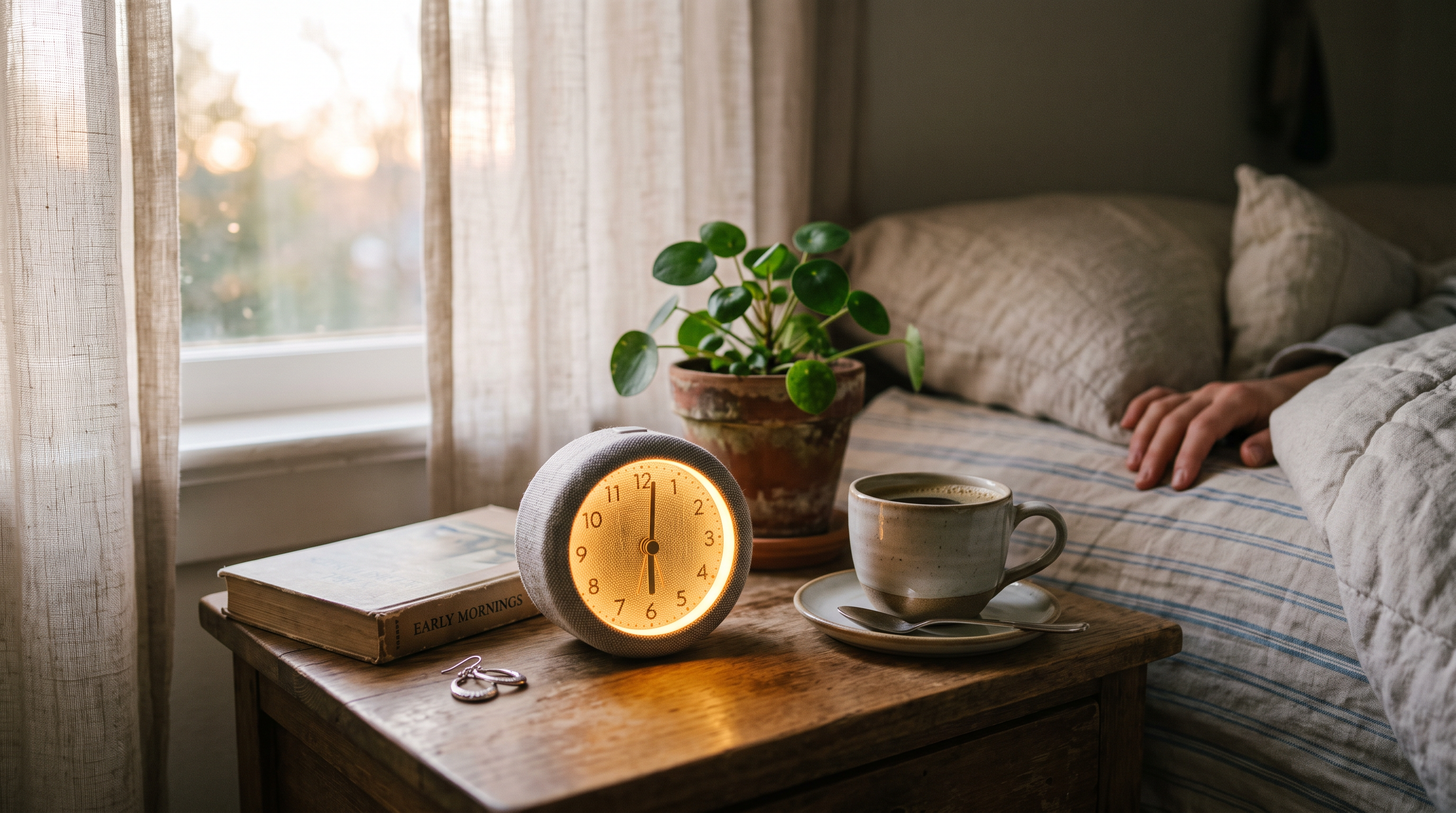
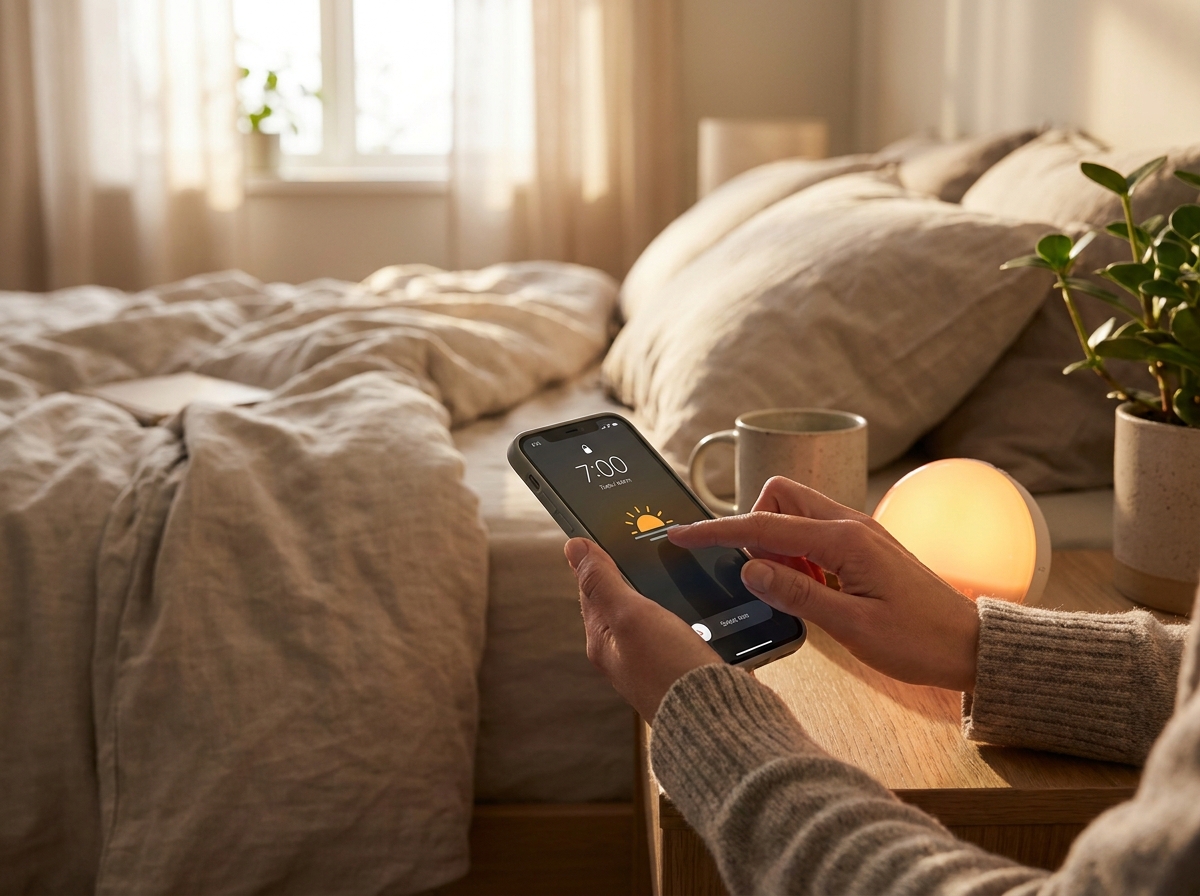
For ten years, my morning routine started the same way: a phone screen, glowing 6 inches from my face, vibrating on the nightstand. I'd slap it silent, then check it. Then check it again. Within ninety seconds I was reading emails. Within five minutes, I was fully awake — but not in any kind of state a sleep researcher would recognise as "rested."
I am, by every available measure, a bad sleeper. I average six hours. I wake up tired. I drink too much coffee. I've tried melatonin, magnesium, no screens after 9pm, white noise, blackout curtains. None of it stuck. The one thing I hadn't tried was the thing staring back at me every morning — the phone itself.
"The first morning the light woke me up, I had a moment of confusion. I was alert before I opened my eyes. That had not happened in years."
So when a small fabric-wrapped alarm clock called the Dreamegg Sunrise Beam showed up on my desk with a note that read "try this instead of your phone for a month," I said yes. The pitch was simple: instead of a screen, a slow, warm light fades up over 30 minutes before your alarm. Instead of a chime, the sound of rain, or wind, or birds. No app. No account. No notifications.
Here's what happened.
A small, almost boring object
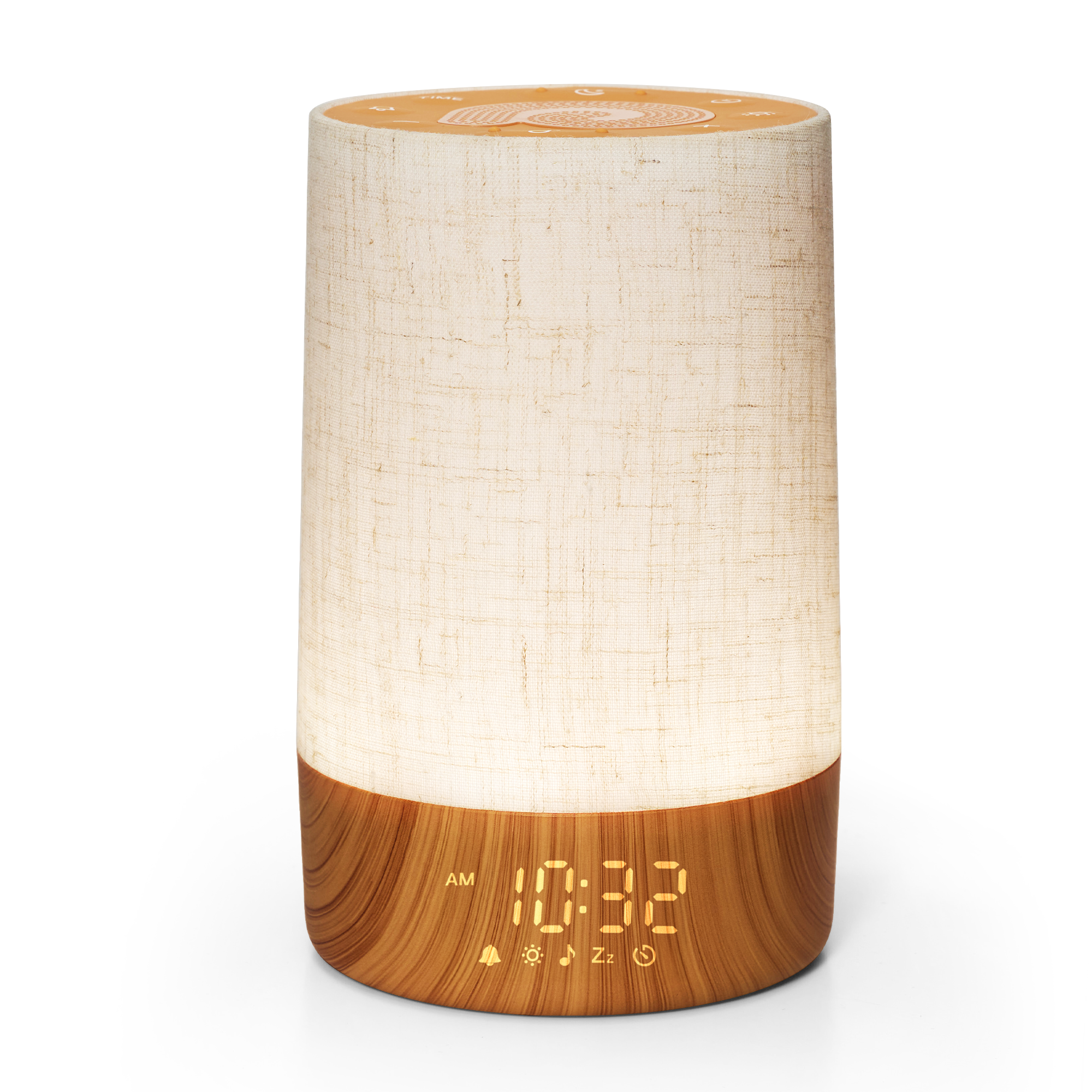
The Dreamegg arrives in plain cardboard. Inside is the clock itself, a power cable, and a small manual. It's about the size of a coffee mug — round, with a fabric mesh cover, a small digital display on the front, and a handful of physical buttons on top. There is no app to download. There is no QR code. There is, refreshingly, nothing to set up.
The first thing I noticed was how quiet it was, even when off. Most alarm clocks have a faint LED hum or a plastic-y tactility that makes them feel like what they are — a small piece of consumer electronics. This one felt closer to a small piece of furniture. My partner said it looked "like a speaker from the 70s." High praise, in our house.
The first morning
I set the alarm for 6:30 a.m. and chose a 30-minute sunrise duration with a soft "birds" sound at 40% volume. I set my phone's alarm as a backup, just in case. Then I put my phone in the kitchen — the first time in a decade it hadn't spent the night on my nightstand.
I slept better that night. Noticing that, in retrospect, wasn't a surprise: there's a small but consistent body of research suggesting that having your phone in the bedroom measurably worsens sleep quality, even when it's face-down. The mere presence of the device changes how the brain anticipates the morning. Removing it helped, even before the clock did anything.
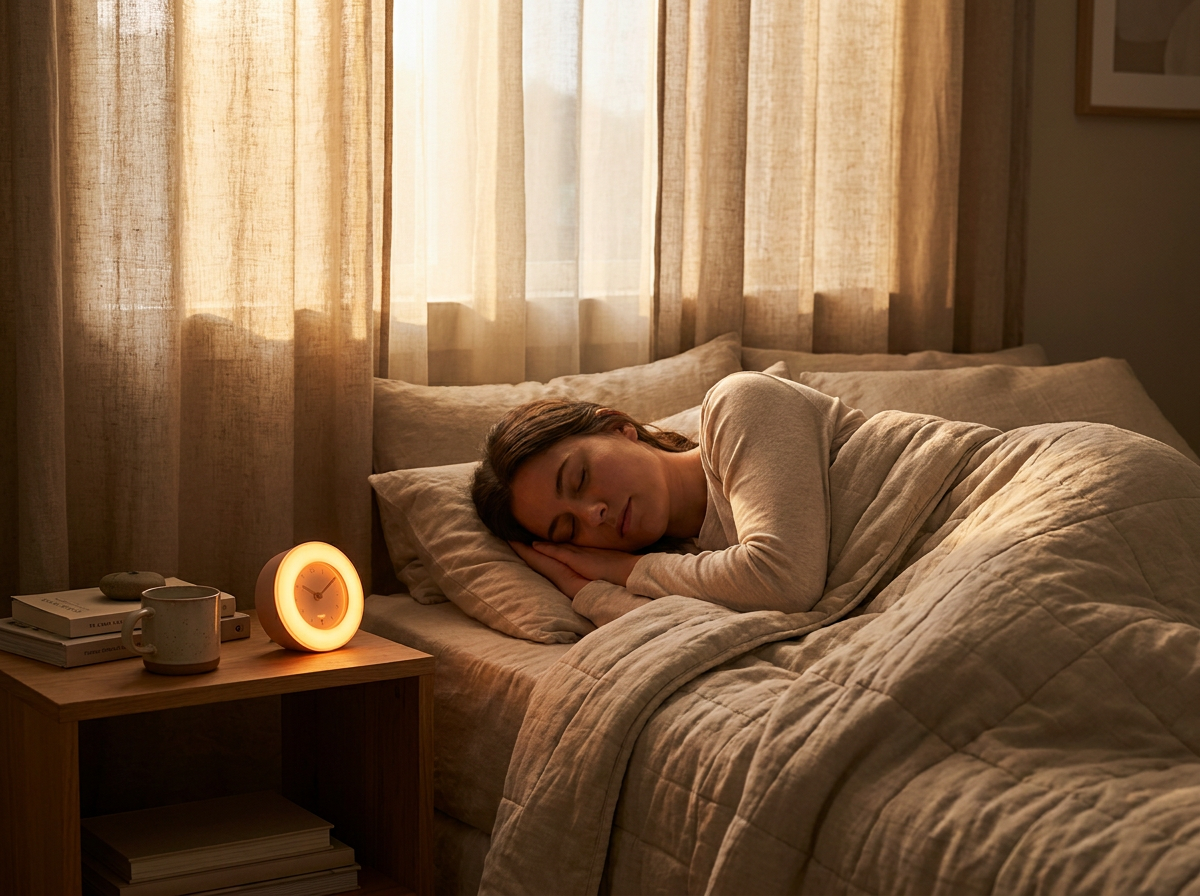
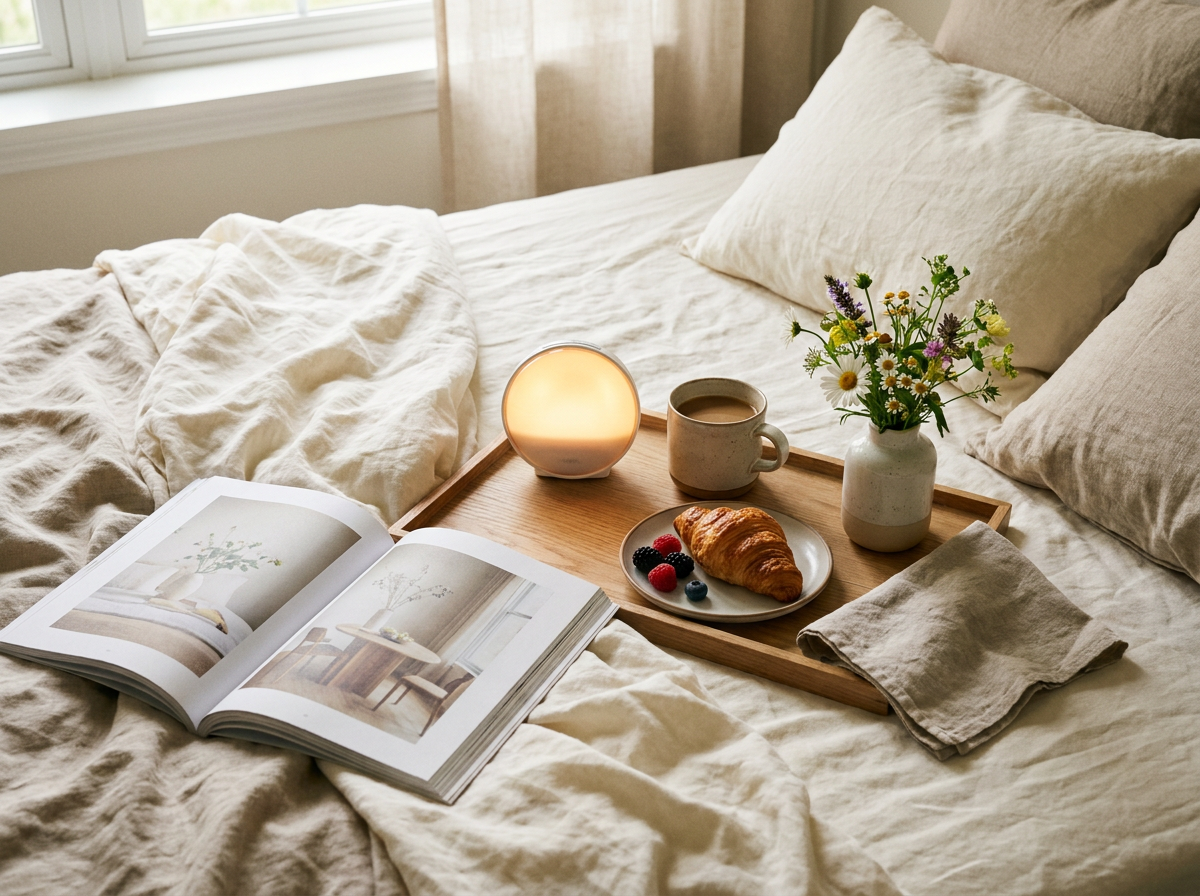
At 6:00 a.m. — thirty minutes before the alarm — the room started to brighten. Slowly, the way a real sunrise does. The light was warm and soft, somewhere between a candle and a reading lamp. I didn't notice it happening, exactly, but my body did. By 6:25, my brain was already gently surfacing from sleep. At 6:30, the birdsong came on, and I opened my eyes without an alarm having gone off — just the light, the sound, and the realization that morning had arrived.
Why this works (and the iPhone doesn't)
The science here is older than you might think. The body's circadian rhythm — the internal clock that tells you when to wake up and when to feel sleepy — is largely driven by light, not by sound. Your eyes contain a specific set of cells (called intrinsically photosensitive retinal ganglion cells) that respond to warm, dawn-like wavelengths and send a signal straight to the brain's master clock, the suprachiasmatic nucleus. That signal says, in essence: it is time to start producing cortisol, raise your body temperature, and prepare for wakefulness.
When your phone alarm goes off, the only signal your brain gets is a sudden loud noise. Cortisol still spikes — but as a stress response, not as a wake response. That's why you feel groggy, irritable, and like you've been hit by a truck. The Dreamegg works upstream of all that. By the time the sound arrives, your body has already done its morning prep. The alarm becomes a confirmation, not a shock.
"Phone alarms wake you up with a threat. Sunrise clocks let your body wake itself up — and then just gently let you know it's done."
30 days in: what changed
I want to be careful here, because the first rule of trying a sleep gadget for a month is that any new behaviour will feel transformative for the first two weeks, simply because you're paying attention. So with that caveat: here is what actually changed.
What got better
I stopped reaching for my phone first thing. This was the biggest, most surprising change. For ten years, my morning started with the phone. Now it starts with the light. By the time I get to the kitchen, my phone is just a phone, not the first thing my eyes touched. That small reordering of the morning has had a bigger effect on my day than any other sleep intervention I've tried.
I fall asleep faster. The Dreamegg has a "sleep timer" feature where you can set one of the 29 sounds to play for 15, 30, 60, or 90 minutes before fading out. I use it most nights with a rain track. The first time I tried it I assumed the sound would keep me up. It did the opposite. I fall asleep, on average, in about 15 minutes — down from closer to 30.
I wake up fewer times per night. I used to wake up at 3 a.m., check the phone, fall back asleep. Now the phone is in the kitchen, so the 3 a.m. wake-up has nothing to grab. It's not gone — but it's shorter, and I fall back asleep faster.
What didn't change
I still drink too much coffee. The Dreamegg does not, sadly, fix everything. I also still have the occasional bad night — the kind where stress keeps you up until 2 a.m. and you wake up at 6 feeling worse than before. The clock helps on the median night. It can't fix a bad one.

The verdict
After 30 days, the Dreamegg Sunrise Beam is staying on my nightstand. It costs $83.00 on the official Dreamegg store — which is, frankly, much less than I expected to pay for a device that has meaningfully changed my mornings. It comes with a 1-year warranty. It does not require an app, a subscription, or a Bluetooth pairing. It is, by some distance, the simplest piece of technology in my house — and the one I'd be slowest to give up.
If you spend your mornings jolted awake by your phone, the experiment is worth it. You don't have to give up your phone entirely. You don't have to become a morning person. You just have to let a small, quiet, fabric-wrapped device try a different way of bringing you into the day. I was skeptical for about a week. By the second week, my partner had quietly ordered one for her own nightstand.
That, more than any review, is the recommendation.
Disclosure: Buydreamegg is a paid partner of this article. The writer tested the product independently for 30 days and was not compensated for a positive review. The Dreamegg Sunrise Beam retails for $83.00 on the official Dreamegg store. Clicking "Get the Dreamegg" may earn Buydreamegg a small commission at no extra cost to you.
Reader comments
127 commentsBought one after reading this. The sunrise is exactly as described. Took me maybe 4 days to adjust. Now I genuinely look forward to mornings, which I never thought I'd say.
♥ 24The "phone in the kitchen" trick alone changed my mornings. The clock is a bonus. Good write-up.
♥ 18I have a 2 a.m. wake-up baby situation. Would this be a terrible idea given the light wakes me gradually? Or is the sound enough?
♥ 9Tried the rain sound last night on a 30-min timer. Best sleep I've had in months. Thank you for not burying the lead on the sleep timer, it's the actual star feature.
♥ 31Article was fair and honest. Bought one anyway. We'll see.
♥ 12Tried the Dreamegg Sunrise Beam? We'd love to hear how it went.
Read 127 reader stories →